How QR Codes Streamline Supply Chain Management
The new product passport for supply chains
QR codes have evolved from simple consumer touchpoints into supply-chain-ready identifiers that act like a digital product passport. By encoding a GTIN plus rich attributes such as batch, lot, serial, and expiry, QR codes in business enable end-to-end visibility, faster exception handling, and data-driven decisions. For leaders pursuing practical digital transformation tools, QR codes connect the physical and digital worlds without overhauling every system at once.
Standards that make scans interoperable
The real unlock comes from standards. GS1 Digital Link and application identifiers allow companies to encode structured data that any compliant scanner or system can interpret. Rather than bespoke labels for every partner, one 2D symbol can carry the data multiple workflows require. For a deeper grounding in what you can include and why it matters, see the GS1 UK guidance on encoding additional data in QR codes powered by GS1.
Turning scans into system actions
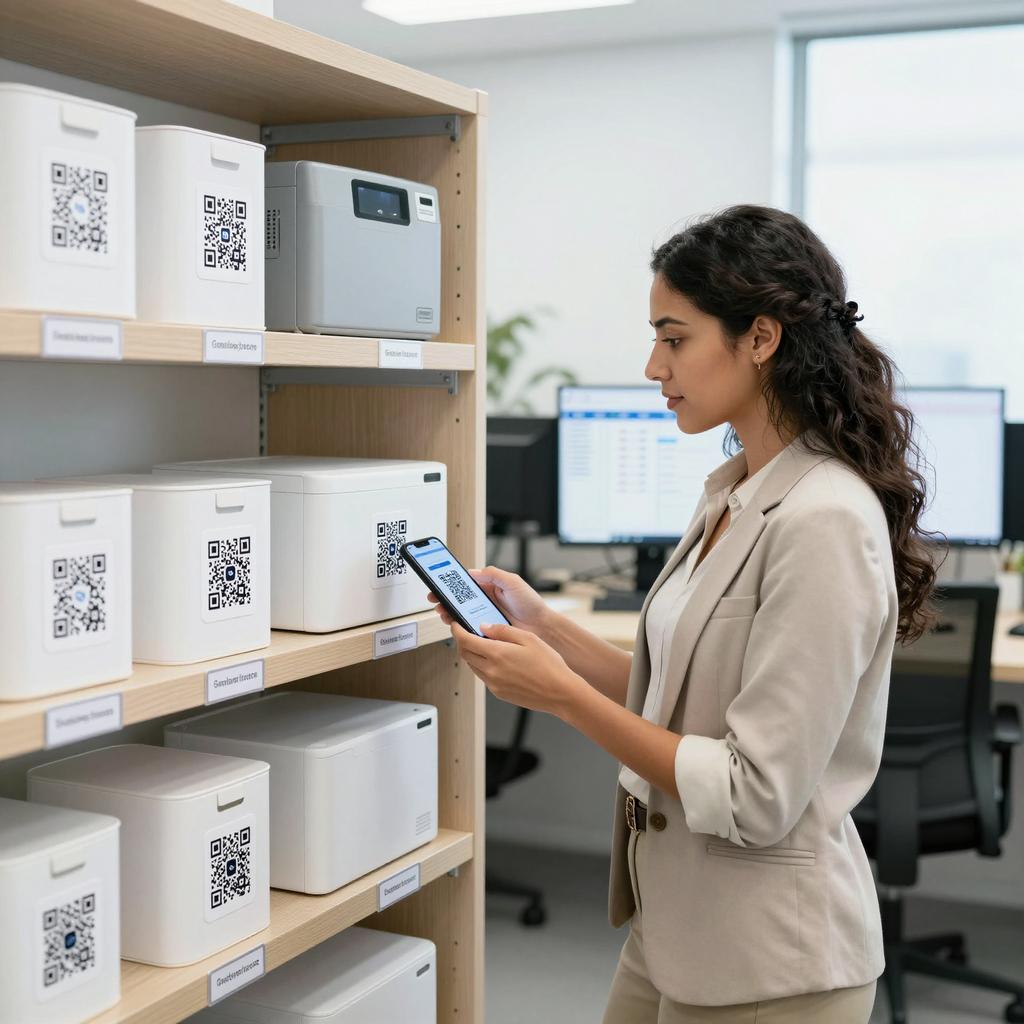
When a worker scans a QR code, your WMS/ERP can parse GS1 elements to trigger precise actions—receive to a specific lot, quarantine suspected items, or decrement serialized inventory. This reduces manual entry and misroutes while improving auditability. Major platforms already support these patterns; explore the Microsoft Dynamics 365 Supply Chain Management documentation on GS1 barcodes and QR codes to see how structured data drives automated workflows.
Where QR codes cut cost and risk
Across inbound, production, distribution, and returns, 2D codes shrink cycle times and error rates. They speed receiving by eliminating keystrokes, sharpen inventory accuracy with serialized tracking, and simplify kitting and rework by attaching context to each unit. In regulated sectors, capturing lot and expiry at scan time improves compliance reporting while slashing the time it takes to isolate at-risk inventory.
Warehouse and inventory accuracy
At the dock, a single scan can capture supplier, PO, lot, and quantity to book receipts in seconds. In storage, location labels and QR-enabled pallet IDs enable guided putaway and cycle counting with fewer touches. During picking, item-level serialization helps prevent swaps and supports automated reconciliation. These changes don’t just shave seconds; they compound into fewer stockouts, lower safety stock, and more reliable planning—tangible ROI for QR codes in business.
Recall readiness and authenticity
Serialization and granular scan history give you traceability at the unit level. If a quality issue emerges, you can trace affected lots forward and backward quickly, notify partners, and surgically remove only impacted items. Standards also deter diversion and counterfeiting by pairing unique identifiers with verification. For a standards primer, review the GS1 US overview of QR Codes and traceability standards.
Customer-facing transparency fuels marketing and demand sensing
The same code that drives warehouse efficiency can deliver post-purchase experiences, sourcing transparency, and warranty registration. Scans from the field enrich demand sensing and service analytics, while dynamic landing pages power modern marketing strategies—promotions, how-to content, and channel attribution—without adding packaging clutter or reprinting for every campaign.
Getting started without ripping and replacing
Start by mapping the data you already track (GTIN, lot, serial) to GS1 application identifiers, then pilot a handful of SKUs where errors are costly. Validate print quality, scanner performance, and label placement in real workflows before scaling. Prioritize integrations that convert scans into actions—not just stored data—and define KPIs like receiving time, inventory accuracy, and recall drill duration. The takeaway: QR codes are practical digital transformation tools that unify operations and customer engagement, delivering fast wins now and a scalable foundation for continuous improvement.